
Beaches of
NormandyTours
NormandyTours
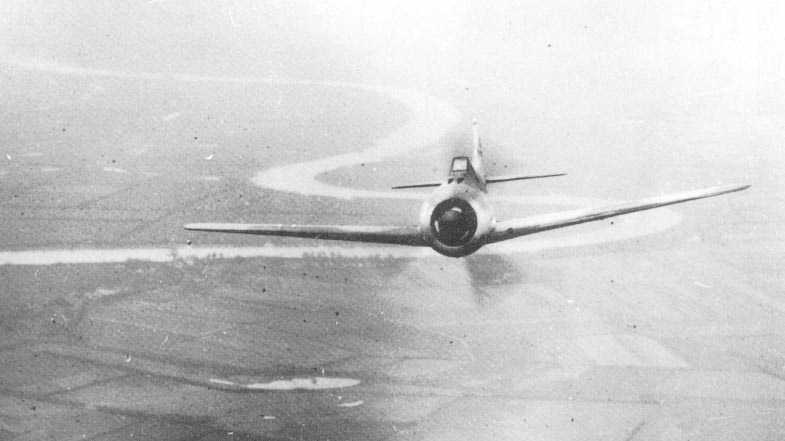
The Focke-Wulf Fw 190 was one of the greatest warplanes not only of Germany, but of World War II at large. Many of the war's iconic planes earned their fame in a specific role – the Supermarine Spitfire (Supermarine Spitfire) as an interceptor, the P-51 Mustang (The P-51 Mustang) as an escort, or the Ilyushin Il-2 as a ground attack plane –, but the Fw 190, the infamous "butcher bird," proved its ability to excel in almost any role for a single-engine plane. It rightfully struck fear in the hearts of the Allies upon its introduction, and was eventually brought low not by any weakness of its own, but the inability of German industry to keep up with the Allied production.
On the eve of World War II, Germany already had a modern and capable fighter in Messerschmitt Bf 109 (The Bf 109), but the Luftwaffe was not going to sit on its laurels. They foresaw that the Allies would eventually have a plane on equal footing with the Bf 109, and were determined to have a plane to trump that plane already in development when it happened. Even before the Bf 109 entered service in late 1937, the German Ministry of Aviation had already sent out a new tender for a plane to fly beside it. Kurt Tank, head of the design department at the Focke-Wulf corporation, submitted several designs. All of these, however, shared a drawback: all used the same Daimler-Benz DB 601 engine that the Bf 109 and the two-engine Bf 110 had, and which was already in short supply. Tank eventually came up with a design that called for the 14-cylinder BMW 139 radial engine, and thus didn't compete with the other fighters for vital parts.
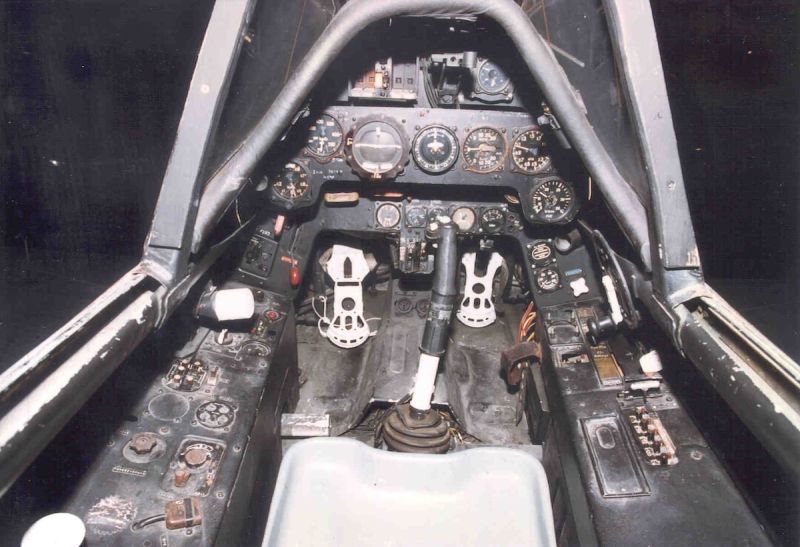
Some sources incorrectly claim that the Fw 190 was the first fighter with a radial, rather than an inline engine; this is incorrect, even though it was the first and only such fighter in the Luftwaffe. Radial engines went out of fashion during the 30s because they were wider than comparable inline engine, which made a plane mounting them thicker in the nose and less aerodynamic. This could be solved by placing an aerodynamic metal ring in front of the engine, but that, in turn, reduced the amount of air that could get inside the engine and cool it. During the first test flight of what would become the Fw 190, the temperature in the cockpit, right behind the engine, climbed to a sizzling 131 °F (55 °C), despite Tank mounting an oversized spinner in the middle of the propeller to push more air into the engine. Early overheating, which originally forced engines to be replaced after 30-40 hours of use, was eventually eliminated by adding a fan that spun over three times faster than the propeller to push air inside, and by adding new ventilation slots.
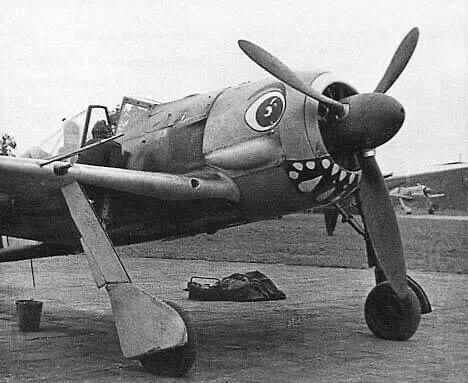
Tank's design philosophy emphasized usability and ruggedness over speed (though it did outfly many contemporaries). He wrote: "[The Bf 109 and the Spitfire] could be likened to racehorses: given the right amount of pampering and easy course, they could outrun anything. But the moment the going became tough they were liable to falter. […] I felt sure that a quite different breed of fighter would also have a place in any future conflict: one that could operate from ill-prepared front-line airfields; one that could be flown and maintained by men who had received only short training; and one that could absorb a reasonable amount of battle damage and still get back. This was the background thinking behind the Focke-Wulf 190; it was not to be a racehorse but a Dienstpferd, a cavalry horse."
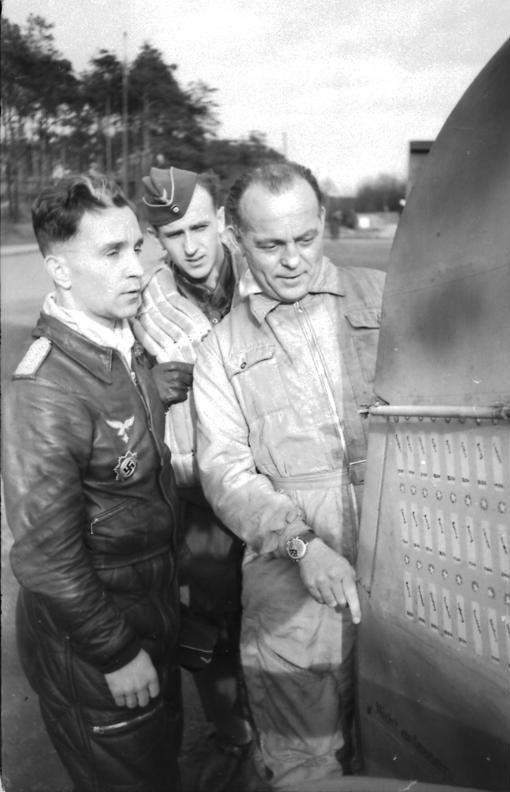
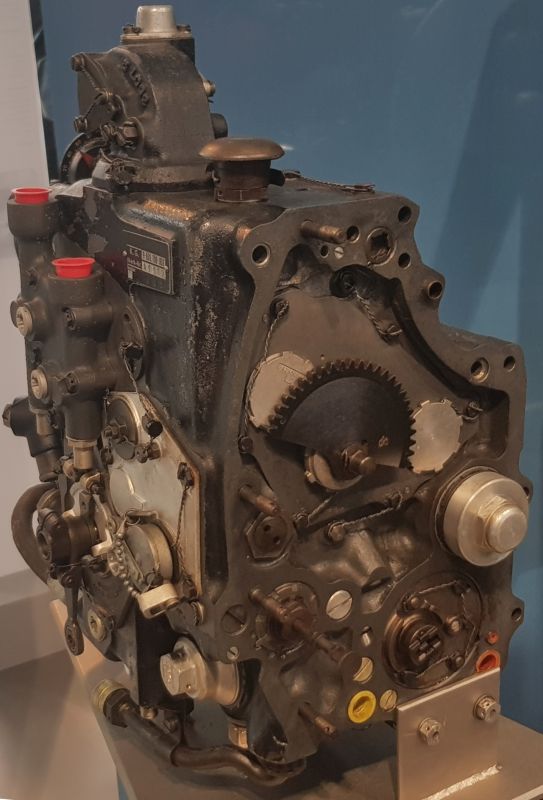
Tank's design principle manifested in many ways. Many hydraulic systems were replaced by electric ones, which were less likely to be damaged in combat. Control surfaces were connected to the cockpit controls not by the usual metal cables that would eventually stretch and make the controls less responsive, but by rigid pushrods and bearings. The ailerons' resistance never exceeded 8 pounds (3.5 kg), since that's the force an average man's wrist can exert. The cockpit was simplified, and settings related to fuel mixture, propeller pitch, boost and magneto timing were all controlled by the Kommandogerät ("command device”), an electro-mechanical computer. (It should be noted that Tank himself admitted the device didn't work perfectly, and some Allied test pilots flying captured Fw 190s said it was more of a hindrance than a help.) The Kommandogerät was an early pioneer of the ECUs (engine control units) that are common in modern cars.
One of the Bf 109's most obvious shortcomings was a pair of long landing gear struts set close to each other, which caused the plane to frequently tip over while taxiing. The Fw 190 had its front gears placed far further out for more stability, and they recessed into the wings inwards; they could withstand a very hard landing with a sink rate of 15 ft/s (4.5 m/s), twice of what was usually required.
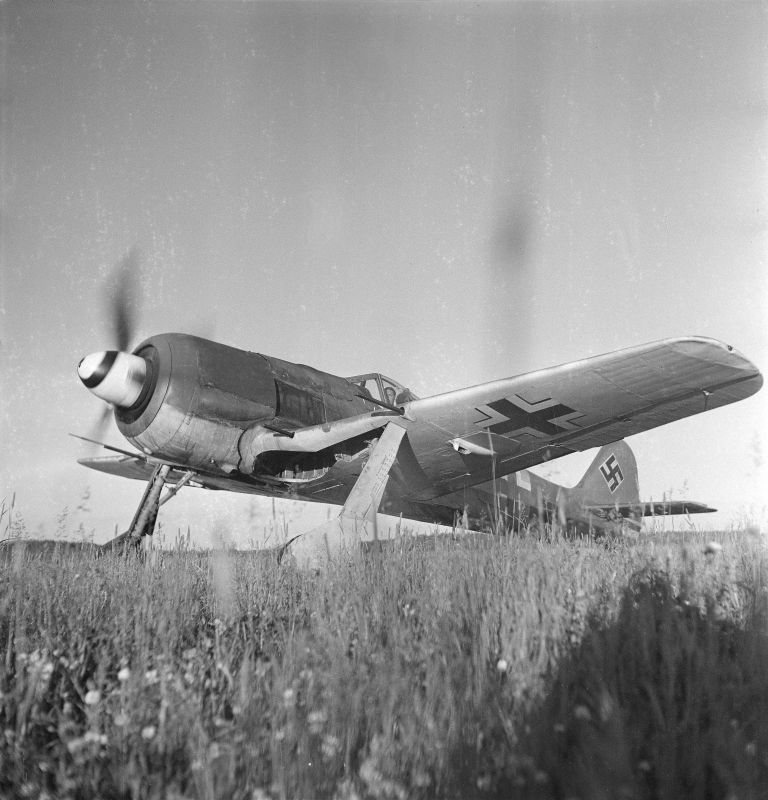
Like the Bf 109, the Fw 190 had relatively small wings. This was a tradeoff: it gave the plane less drag and therefore higher speed and better agility, but also a higher stall speed limit, and made it perform poorly at high altitudes. The already powerful BMW 139 engines were quickly replaced with even stronger BMW 801s.
The pre-production model was armed with six 15 mm (.312 caliber) MG 17 machine guns; two in the nose and two in the wing roots, synchronized to shoot between the propeller blades, and two further out on the wings firing freely. This was quickly upgraded in later models. Numerous versions of the Fw 190 existed with a variety of armament loadouts. The most common variety, the A-8, which accounted for 6,655 of the over 20,000 made, carried two machine guns and four 20 mm autocannons. Some versions had fewer cannons to make the plane lighter and give it longer range or the ability to carry more bombs or a torpedo; others traded two of the 20 mm guns for 30 mm ones, or for a pair of external gun pods with two 20 mm guns in each.
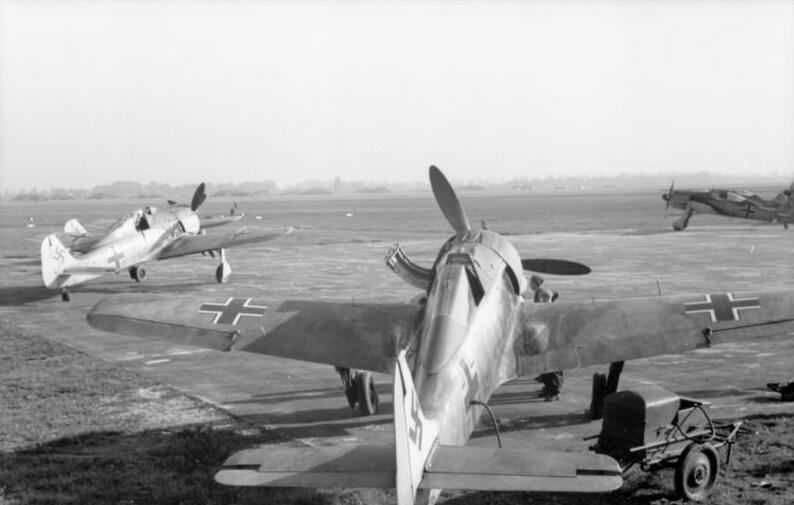
The Fw 190 was given the nickname Würger, "Shrike" in English. It was also known as the "butcher bird," a name for several shrike species that impale the insects, rodents and lizards they catch on the thorns of plants. The sinister name was well-earned in service. The Shrike entered service in August 1941. Its first major mission came in February 1942, when it flew air cover during Operation Cerberus, also called the Channel Dash, in which two German battleships and a heavy cruiser rushed through the Straits of Dover to get out into the Atlantic. In August the same year, 115 Fw 190s squared off against over 300 Royal Air Force (RAF) fighters in the skies during the ill-fated Dieppe Raid (The Dieppe Raid). 25 Shrikes and 61 British planes were lost, establishing the Fw 190 as a very dangerous plane. At its introduction, it outperformed the Spitfire Mk. V in every metric except for turn radius so much that the Allies first believed they were facing American Curtiss P-36s the Germans captured from the French. The Fw 190 also performed well in the fighter-bomber role, as it could fly below effective radar coverage and get in and out at high speed. Later in the war, Fw 190 fighter-bomber units in the region were transformed into a night bomber role, in which they took heavy casualties from the British de Havilland Mosquito (De Havilland Mosquito) night fighters.
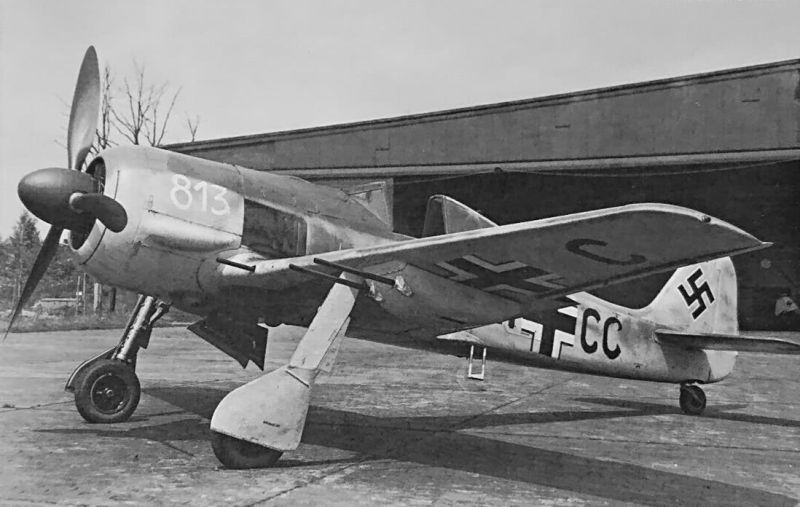
Mounting losses prompted the Allies to plan a commando raid on a Luftwaffe airfield and steal a Shrike for study. The plan was scrapped due to a bout of good luck. On June 23, 1942, a group of Fw 190s got into combat against RAF planes over Devon in Southwest England. First Lieutenant Armin Faber got separated from his unit. Disoriented, he thought he was flying south across the English Channel to France, but he was, in fact, flying north across the Bristol Channel, and he landed at an RAF base in Wales, unintentionally delivering the Allies their first Butcher Bird and rendering the commando raid moot.
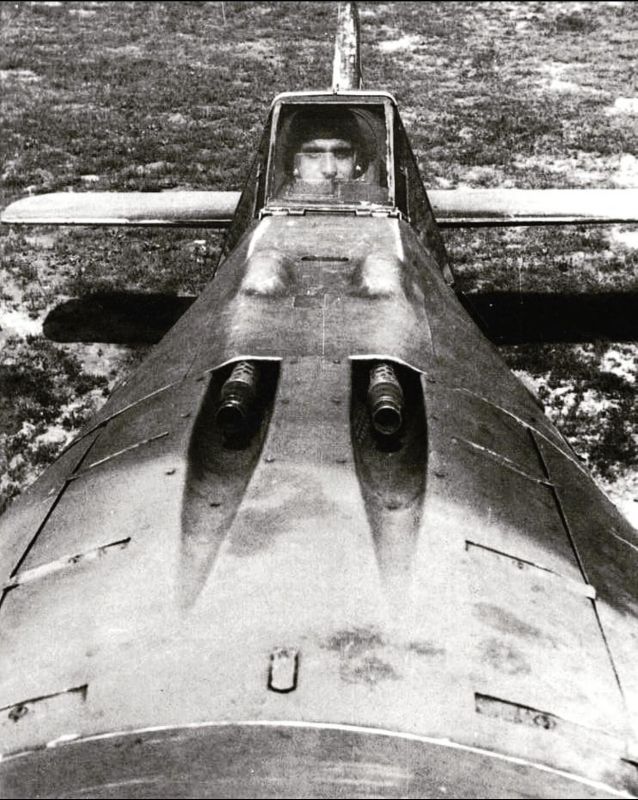
The Shrike also performed well on the Eastern Front, where it was present from September 1942 onwards. Its sturdiness and wide undercarriage made it better suited for the primitive local airstrips than the Bf-109.
The Fw 190 performed with brutal efficiency during the famous Battle of Kursk (The Largest Tank Battle in History). On one day, the 1st Air Division destroyed 50 Soviet planes in just a few hours. On another date, Fw 190s downed 121 enemies while only losing two. Slow-flying Soviet bombers and the escorts that were ordered to stay close to them were easy targets. The Soviets suffered such high losses that they were forced to change tactics and launch small-scale fighter sweeps to engage Fw 190s without being encumbered by bombers. Once the German ground offensive ran out of steam, the Shrikes flew effective fighter-bomber missions to help out the ground effort. In the end, the Germans lost Kursk and went on a slow backslide they could not stop. The Fw 190’s kill-lose ratio also started slipping thanks to the overall deterioration of the situation all along the front.
With German lines breaking down during the long westward retreat, the Shrike became the first line of defense. Fw 190s would make recon missions in the morning to locate Soviet troop movements, and then they would attack Red Army armored spearheads that got behind German lines. If the Soviet tanks were already engaged with German armor, they would drop bombs on them from the extremely low altitude of 13 to 32 feet (4 to 10 m). If the Soviet armor was not in combat, the planes attacked their soft-skinned supporting vehicles, cutting off fuel and ammunition supplies. Supplies were so low by this time that planes were towed from the dispersal area to the takeoff point by animals to save on fuel, and pilots were told to switch off the engine immediately upon landing.
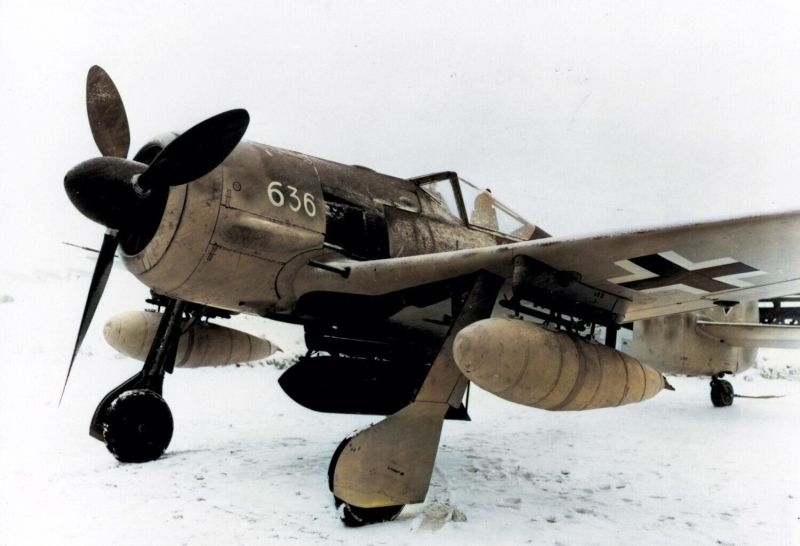
The Fw 190 also fought in North Africa, though it arrived too late to make an impact, and continued to fly missions in the Mediterranean afterwards.
The Fw 190 was produced in several concurrent series, each containing numerous versions with smaller or larger differences. The A-series (“Anton,” following the German phonetic alphabet code), produced throughout the war, was the "basic" version of the plane. Like the other series, it came with a variety of Umrüst-Bausatz factory conversion sets and Rüstsatz field conversion kits. These could be applied to finished planes either in the factory or at airstrips, and contained a range of modifications including rocket launchers, bomb racks, recon cameras, gun pods, heavier cannons or special radios for formation leaders.
Many A-series Fw 190s served as night fighters trying to intercept RAF bombers over Germany. The development of "window," an early form of chaff, rendered the established German night interceptor tactic unusable, as ground radar could no longer guide the planes to the heavy bombers. The new Wilde Sau ("Wild Boar") tactic called for the planes to act on their own and stay over the city being bombed, hoping to spot the silhouette of British bombers against the fires down below or with the aid of ground-based searchlights. This tactic, however, caused heavy German losses early on, as many pilots crashed while trying to land in the dark or simply bailed out after failing to locate an airfield to land at. The use of blind-flying radio equipment eventually reduced such casualties.
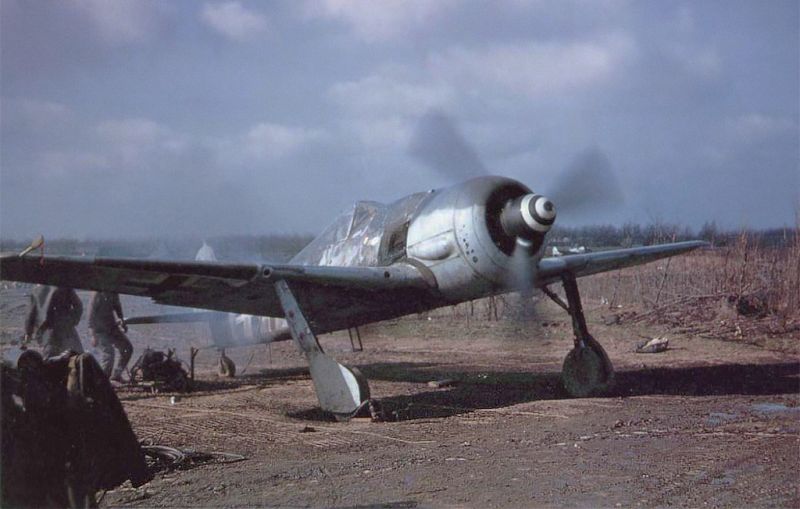
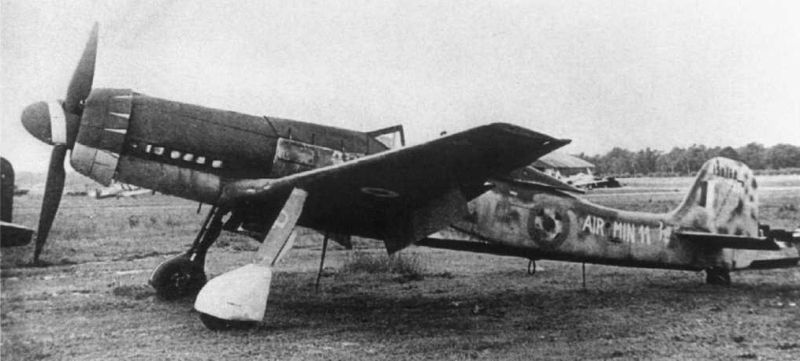
As mentioned before, the small wings gave the Fw 190 poor high-altitude performance, which made the A series inefficient against Allied heavy bomber formations. Experiments to fix the problem led to the short-lived B and C, and eventually the successful D-series. The “Dora” had the radial engines swapped for an inline Junkers Jumo 213 power plant, which had a built-in supercharger for much better performance in the rare atmosphere at high altitudes. The series also featured other changes including a pressurized cockpit for high-altitude flight, a methane-water injector for short bursts of extra power, and a longer nose and tail for better balance while carrying the new engine – this last change earned it the nickname “Long-Nose Dora.” It was a good bomber-killer, but only entered service in late 1944, by when it was a bit too late for that job, and it mainly saw combat against Allied fighters and ground targets. It lacked the high roll rate of the A-series due to not having a radial engine, but was faster and had better climb and dive characteristics, making it great for the dive-and-zoom ambush tactics the Germans favored. Some D-series planes were used to guard Me 262 jets (Ushering in the Jet Age) when they took off or landed, which was when they were the most vulnerable. These Shrikes had their undersides painted bright red with white stripes so flak crews around the airfields wouldn't shoot them down by accident. The paintjob earned them the nickname "parrot squadron."
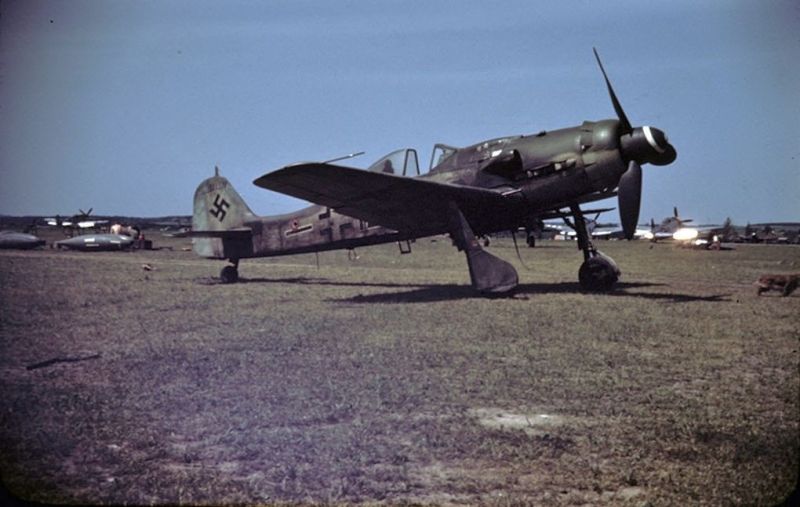
The F-series specialized in a ground attack role and saw heavy use on the Eastern Front, where a lack of Soviet heavy bombers rendered high-altitude interceptions unnecessary, and freed up planes for close support missions. These versions were given extra armor to protect the pilot, the fuel tank, the engine cowling, the landing gear mechanism and the outer wing guns against ground fire; predictably, they also had bomb racks. The most common version, the F-8, had two 13 mm (.51 caliber) machine guns and two 20 mm cannons, and came with various factory conversion kits, some of which allowed it to carry a torpedo. It was also used as a testbed for various anti-tank rockets and missiles.
Inspired by the success of the F-series, the G-series was designed for long-range fighter-bomber missions, and carried a variety of bombs and external fuel tanks. In order to reach a longer operational range, its armament was lightened by the removal of all but two guns, though some versions could also carry external cannon pod. The S-series, of which only some 60 were made, were two-seater training craft.
The Focke-Wulf Ta 152 was designed as a direct successor of the Fw 190. It had the promise of an excellent all-around fighter with great performance, doing an impressive 469 mph (755 km/h) at 44,300 ft (13,500 m) with nitrous oxide boost. However, it came too late to make a difference and suffered from some teething problems, and only around 69 were built before the end of the war.
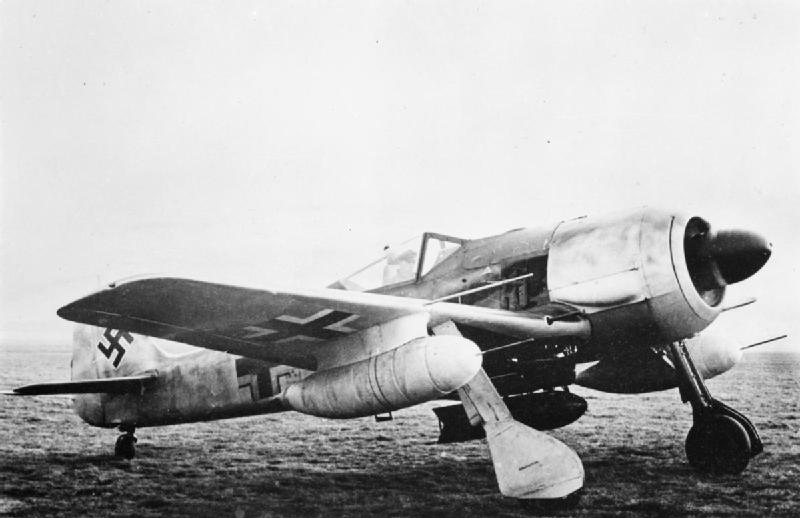
A special mention must be given to the so-called Sturmbock ("Battering Ram") models, which were conversions of the A-8 model. These were specifically designed to deliver a deadly punch to American heavy bomber formations late in the war. Before the arrival of long-range escorts, most notably the P-51 Mustang, bomber streams flew unescorted and were vulnerable to attacks by the heavily armed twin-engine Bf 110 bomber destroyers. Once escort fighters such as the P-38 (Like Lightning From a Clear Sky), P-47 and eventually the P-51 became available and were allowed to stray far from the bomber streams as they hunted down German interceptors, they started making short work of the sluggish Bf 110s, forcing the Luftwaffe to look for a plane that could do the same job while being maneuverable enough to stand up to the escorts. Sturmbock Fw 190s were well-armored, carried murderous, cheap and simple-to-make 30 mm cannons as part of their armament, and had Werfer-Granate 21 (Werfer-Granate 21) rockets which could break up bomber formations so the planes could no longer cover each other effectively. All the extra armor and armament, however, slowed them down to the point where they became just as easy targets for escort fighters, especially ones going well in advance of the bomber stream in a "fighter sweep," as the Bf 110s they were meant to replace. The German workaround solution was to match these Sturmbock units with agile Bf 109 units, which would, ideally, keep the escort fighters busy while the Shrikes went for the kill on the bombers. This ran into practical problems, as the mixed formations were slow to assemble in the air and difficult to control as one.
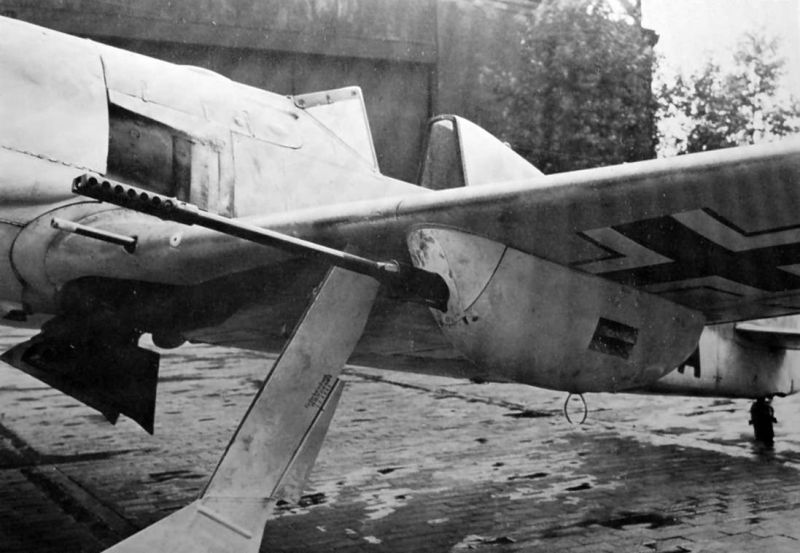
The Fw 190, along with other planes, was also used in the Mistel (“Mistletoe”) composite aircraft configuration. The Mistel comprised a smaller craft (such as the Shrike) riding on top of a larger one, often a Junkers Ju 88 bombers, whose nose was modified and stuffed with explosives to create a large shaped charge. The contraption was controlled by the pilot in the top vehicle, who would detach the bomber and release it towards a target. Some 250 Mistels were built (not all of them with Fw 190s as the control plane) and they were first deployed in combat during the Normandy landings, but they failed to achieve much effect.
So how did the Shrike match up against its most common opponents? When it started seeing combat in August 1941, it was a massive surprise to the Allies. It was superior to the then-current Spitfire, the Mk V, which was to be its main adversary at the time. It was also a match for many other early war fighters, including Soviet aircraft, the P-40 Warhawk, and early versions of the P-38 Lightning and the P-47 Thunderbolt. Initially, the Shrike’s main weakness was high-altitude performance.
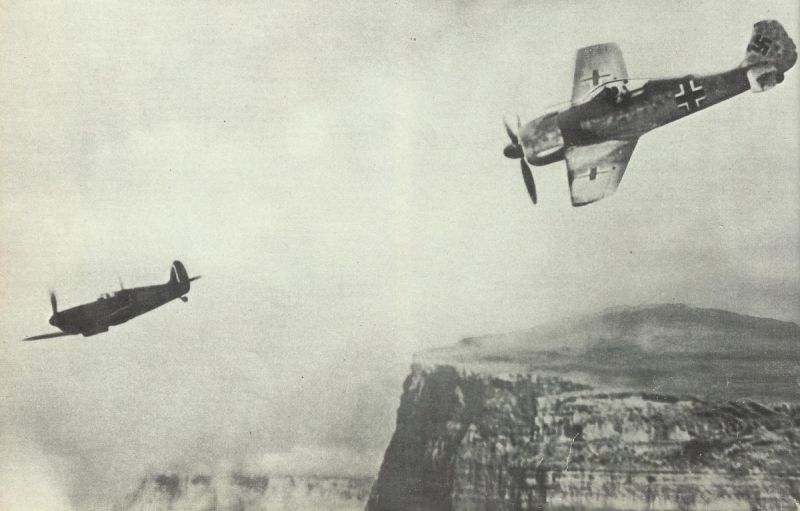
But then the situation changed, as the Allies had the resources to make significant improvements to their craft and come up with new designs, while the Germans couldn’t keep up with the pace of development. The Spitfire Mk IX, equipped with a more powerful engine, returned the balance of power in favor of the British. The appearance of the P-51 Mustang in the European Theater of Operations introduced a plane that had the advantage at the high altitudes where they were escorting the Allied bombers. (Though a Fw 190 could still surprise a Mustang at low altitude.) New planes introduced late in the war, such as the Hawker Tempest, the small Lavochkin La-7 and the nimble Yakovlev Yak-3 could outfight the contemporary versions of the Fw 190. Another factor, of course, was the industrial disparity: on average, a Shrike attacking an American bomber stream was not facing one Mustang, it was facing 6-8. While it was a terror in the sky in its heyday, the Fw 190 was eventually brought low by sheer numbers and its inability to keep up with new technological improvements. Additionally, attrition gradually deprived the Luftwaffe of experienced pilots.
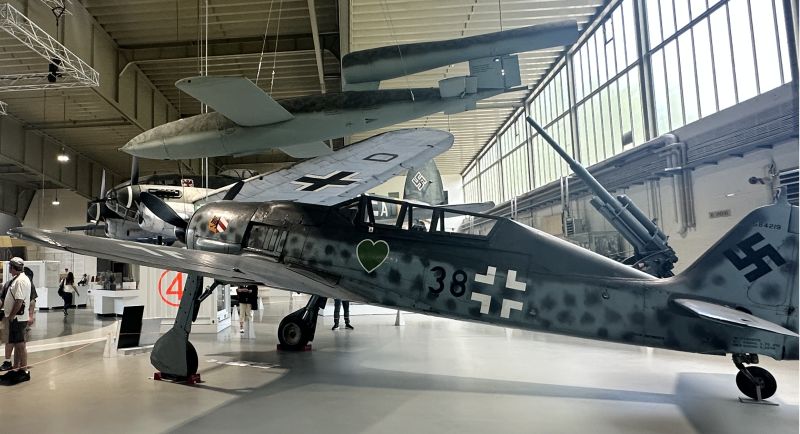
At least 23 Fw 190s survive to this day, with only one in flying condition. Among others, you can find examples at the National Museum of the United States Air Force, the Royal Air Force Museum London, and the Military History Museum at Berlin-Gatow Airport. The National Air and Space Museum in the U.S. also stores the single known surviving Ta 152, and a small German company has produced over 20 reproductions, many of them airworthy (though flying with different engines, since the originals are no longer available).
Join us on our Third Reich Tour to see one of the few surviving FW 190s at the Military History Museum of the Bundeswehr in Gatow, Berlin.








Beaches of Normandy Tours
Beaches of Normandy Tours SAS, Normandy, France
Band of Brothers Tours
Band of Brothers Tours FZCO, Dubai, UAE